What does one completed AI task actually cost?
Count the work needed to reach an accepted result, including the work a person still has to do.
By Valentin Shapovalov · 11 October 2026 · Includes an interactive example and worksheet
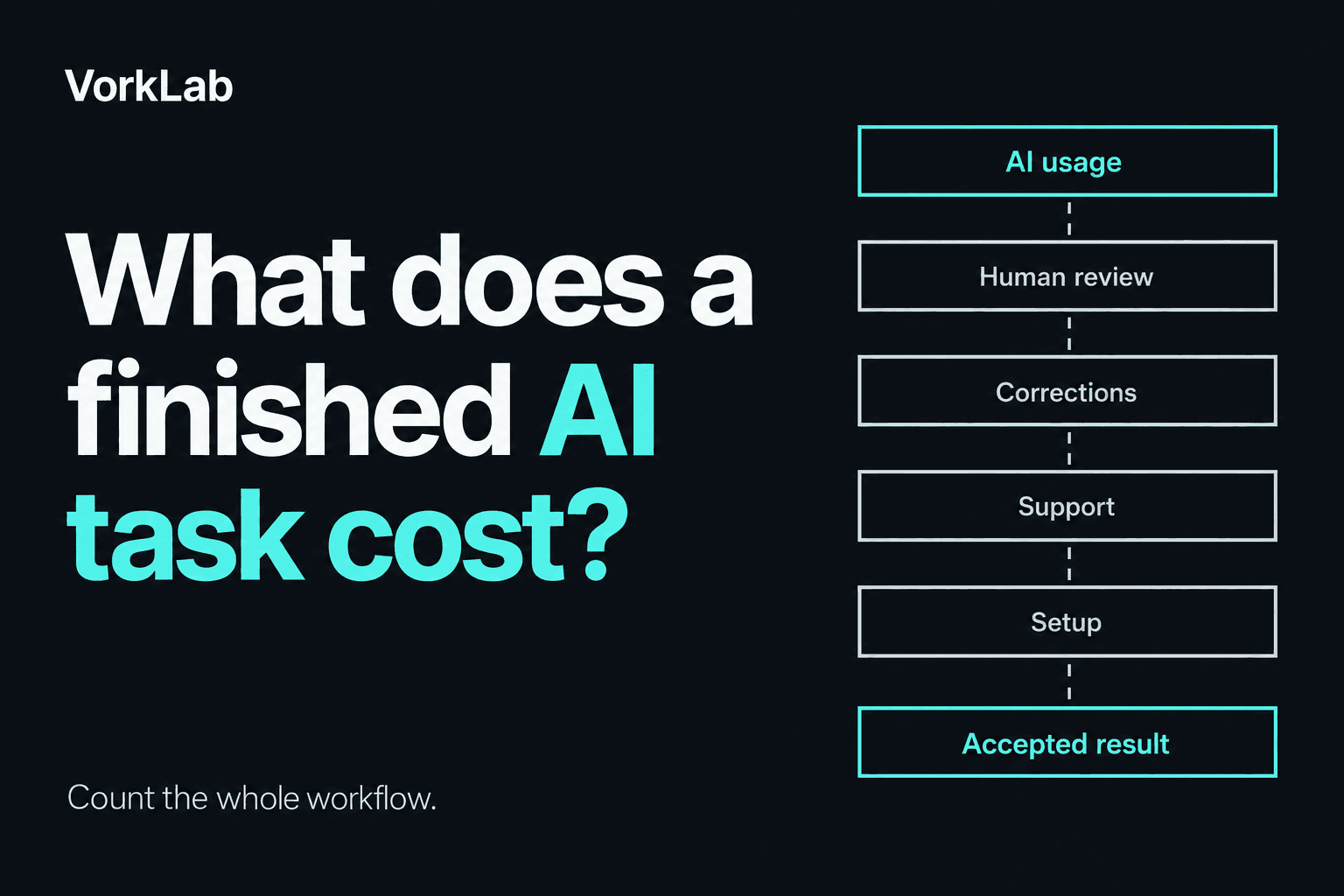
Model and tool usage averages five cents per enquiry. After review, corrections, maintenance and allocated setup, the accepted result costs $2.15.
That is still below the $3 manual baseline in the example below. It is also a very different number to budget around. Every figure in this example is illustrative.
A useful automation proposal should explain how much work reaches an acceptable finish, what it costs, and what happens to the exceptions. The model invoice answers only part of that question.
The FinOps Foundation separates resource metrics, such as cost per token, from business metrics, such as cost per resolved case. For a small team, this distinction can be made concrete with one workflow and a short cost ledger.
First, agree on what counts as finished
Take an incoming sales enquiry. For this article, a completed task means: the right details are recorded once in the CRM, a correct reply has been sent under the agreed rules, and the action is confirmed. Missing information has been resolved, or the enquiry has reached a defined final exception outcome, such as a valid closure for an unsupported request. Sending it to a person for further work does not count as completion.
A draft alone does not meet that definition. Neither does an agent saying it sent the reply. Anthropic's guide to agent evaluation makes the same distinction: the outcome must be checked in the system where the work happened.
Count unique accepted enquiries. Three attempts to process one enquiry still produce, at most, one accepted result. A task rescued by a person counts as a result of the combined workflow. Record separately whether it needed human completion.
Compare approaches on the same workload, quality requirements and deadline. Also report unresolved cases and time to completion. A low cost per completed task can hide a growing queue of difficult work.
Put all the work in the numerator
Cost per accepted result
All costs attributable to the workflow
÷ Unique accepted results
Use matching costs and outcomes. For a pilot, follow one batch of enquiries through completion and attach all its attempts and corrections to that batch.
- Model and tool usage. Include retrieval, external services, paid actions and every retry, including attempts that fail.
- Human handling. Include review, corrections, manual fallback and quality checks. Count the same minute once.
- Ongoing operation. Include additional hosting, monitoring, support and the work needed when integrations or business rules change.
- Implementation. Include process design, data preparation, integration, testing, training and handover. Show the upfront amount and the period over which you allocate it.
FinOps guidance explicitly identifies repeated requests and human remediation as consequences of poor output quality. A cheaper model can therefore make the whole workflow more expensive if people spend longer fixing its work.
If 1,000 enquiries consume $2,150 but only 900 meet the acceptance criteria, the cost is about $2.39 per accepted result. The other 100 remain visible as unresolved or rejected work, with any later recovery costs still to come. Keep their costs in the calculation.
One workload, three ways to complete it
Assume 1,000 enquiries per month and a loaded handling cost of $30 per hour. Loaded means the cost of staff time including employer costs. Manual handling takes six minutes per enquiry, including its normal checks and corrections.
A. People complete the work
1,000 × 6 minutes is 100 hours. At $30 per hour, monthly handling costs $3,000.
B. AI drafts; a person checks and completes
Every enquiry takes two minutes to check and finish. In 20% of cases, the draft is insufficient and needs another six minutes of manual work. That is 3,200 minutes, costing $1,600. The additional six minutes are counted after the initial review.
Model and tool usage, including retries, averages $0.05 per incoming enquiry. Additional operation and support costs $250 a month. A $3,000 implementation is allocated over 12 months, adding $250 a month.
C. AI completes permitted cases; people handle exceptions
Assume 70% follow the automatic path, 20% need two minutes of human review and completion, and 10% go directly to six minutes of manual handling. These are separate paths. The direct handoffs do not also receive the two-minute review.
Separately, staff audit 10% of the 700 automatic-path results, at two minutes each. Total handling and audit time is 1,140 minutes, costing $570. This sample is a cost assumption, not proof that all automatic results are correct. Errors discovered in practice require extra correction work and a revised count of accepted results.
Usage averages $0.15 per incoming enquiry, including retries. Additional operation and support costs $600 a month. A $12,000 implementation, allocated over 12 months, adds $1,000 a month. Support includes maintenance labour; it excludes enquiry handling already counted above.
The result changes with the volume
What changes with volume?
Illustrative model · USDChange monthly enquiries. Every enquiry is assumed to reach an accepted outcome, including human fallback. These are fictional assumptions, not measured results or a quote.
Manual work
$3.00
per accepted result
$3,000 / month
Comparison baseline
AI drafts + review
$2.15
per accepted result
$2,150 / month
$850 less per month than manual
Bounded automation
$2.32
per accepted result
$2,320 / month
$680 less per month than manual
At 1,000 monthly enquiries: Manual work, $3,000 per month, $3.00 per accepted result. AI drafts + review, $2,150 per month, $2.15 per accepted result. Bounded automation, $2,320 per month, $2.32 per accepted result.
Inspect costs and assumptions
Manual work
- Human handling
- $3,000
- Handling minutes
- 6,000
- AI + tools, with retries
- $0
- Ongoing support
- $0
- Operating subtotal
- $3,000
- Allocated setup
- $0
AI drafts + review
- Human handling
- $1,600
- Handling minutes
- 3,200
- AI + tools, with retries
- $50
- Ongoing support
- $250
- Operating subtotal
- $1,900
- Allocated setup
- $250
Bounded automation
- Human handling
- $570
- Handling minutes
- 1,140
- AI + tools, with retries
- $150
- Ongoing support
- $600
- Operating subtotal
- $1,320
- Allocated setup
- $1,000
Human time: $30/hour. Manual work takes 6 minutes per enquiry. AI drafts need 2 minutes of review on every enquiry, plus another 6 minutes of rework on 20% of enquiries.
Bounded automation routes 20% to a person for 2 minutes of assistance and 10% directly to manual handling for 6 minutes. The remaining 70% run automatically; a 10% sample of that group receives a 2-minute quality check. Sampling alone does not establish that every outcome was accepted.
AI and tools cost $0.05 per incoming enquiry for drafts and $0.15 for bounded automation, including retries. Monthly support is $250 and $600 respectively and includes support labor. Handling minutes above exclude this support time.
Setup is $3,000 for drafts and $12,000 for bounded automation, allocated evenly over 12 months. All totals include that allocation. It spreads the cost for comparison; it does not change when you pay. For each selected volume, that monthly workload is assumed to continue throughout the 12-month allocation period. Routing proportions, handling times and fixed support costs stay unchanged.
Lower modeled handling cost is not automatically a cash saving. Salaries only fall if spending changes; released capacity has value when you can use it.
At 1,000 enquiries, reviewed drafts cost $2.15 per accepted result. The more autonomous approach costs $2.32. It uses less handling time, but its higher setup and support costs outweigh that advantage at this volume.
At 200 enquiries, manual handling is the lowest-cost option in this model. At 2,000, the more autonomous approach costs $1.52 per result, compared with $1.90 for reviewed drafts and $3 manually. The work mix, handling times and fixed support costs are held constant here. Real systems may need more support or infrastructure as volume grows.
The calculation does not establish a universal winner. AI Agents That Matter argues for evaluating cost alongside performance, while Anthropic recommends adding agentic complexity when the task justifies it. Your own workload determines whether that extra complexity earns its cost.
One extra minute can change the decision
In the reviewed-draft option, increasing review time from two to three minutes adds $500 a month at 1,000 enquiries. Cost per accepted result rises from $2.15 to $2.65.
If review still takes two minutes but 30% of drafts need manual rework instead of 20%, cost rises to $2.45. Each of these changes matters more than the entire $50 monthly model-and-tool bill in that scenario.
That makes review time and exception frequency useful pilot measurements. Test your optimistic assumptions as well as a slower-review, higher-rework case. Check whether the decision survives both.
Freed time and cash savings are different
Reviewed drafts reduce enquiry-handling time from 100 to about 53.3 hours a month in the example. That releases about 46.7 hours of capacity. If salaries stay the same, payroll does not fall by the value of those hours. Additional maintenance effort is budgeted separately in support.
The business benefit depends on what changes: fewer paid overtime hours, less outsourced work, an avoided hire, or more useful work completed with the same team. If nobody can use the released capacity, its practical value may be much smaller than the labour-cost comparison suggests.
Keep an economic view and a cash view. The first values staff time. The second records actual additional payments and costs genuinely removed. Measure extra revenue or faster response separately, using evidence from your own process.
Allocating setup over 12 months is a planning convention. It does not turn a $3,000 invoice into a $250 payment. In this simplified example, setup is paid upfront. If monthly net cash benefit stays constant, estimate cash payback by dividing upfront spending by that benefit after additional operating payments. If it stays zero or negative, there is no cash payback. For changing benefits, track cumulative net cash flow until it covers the upfront spending.
Measure one small workflow before expanding
- 1. Establish a manual baseline. Measure handling time, corrections, quality and completion time on representative work. Include difficult cases.
- 2. Agree on acceptance before the trial. Define the required result, prohibited errors, deadline and evidence. Keep those rules the same across approaches.
- 3. Log the whole journey. Use one enquiry ID across model calls, retries, reviews and final actions. Record human minutes and the reason for each handoff.
- 4. Compare a similar mix of work. Where practical, allocate comparable enquiries between the existing and assisted process. A small trial can reveal failure modes without establishing a precise long-term error rate.
- 5. Review the decision. Look at cost per accepted result alongside unresolved work, serious errors, response time and human involvement. Repeat after material changes to the workflow.
AWS guidance treats maintaining business value as an ongoing activity. Costs, usage and performance can change after launch. Keep the calculation close to the operating data rather than leaving it in the original proposal.
Some errors should block a rollout regardless of average unit cost. Track their severity separately. The worked example budgets for normal rework; it does not price every possible consequence of an incorrect external action.
Build your own cost ledger
The worksheet includes acceptance criteria, cost categories, formulas and a separate cash-benefit check. Use observed pilot data where you have it, and label estimates where you do not.
Download the worksheetPlain text · No sign-up
If you are still choosing the workflow, start with the Automation Planning Guide. Then bring the proposed scope, a few representative enquiries and your baseline to the cost calculation.
Sources and method
This guide combines the sources below with an original illustrative cost model. The sources support the evaluation approach; they do not establish the example's prices, handling times or routing rates. Sources checked on 11 October 2026. No model tariff or universal savings estimate is assumed.
- 1. FinOps Foundation: Unit Economics
Distinguishes the cost of a resource from the cost of a business outcome.
- 2. FinOps Foundation: AI Tools & Services Considerations
Discusses repeat requests, failed workflows and human remediation as cost drivers.
- 3. Anthropic: Demystifying evals for AI agents
Explains why an agent's claimed success and the actual result must be evaluated separately. January 2026.
- 4. Kapoor et al.: AI Agents That Matter
Research on evaluating agent cost alongside task performance. A benchmark study, not a business ROI estimate. 2024.
- 5. Anthropic: Building effective agents
Discusses the cost and latency tradeoffs of adding agentic complexity. December 2024.
- 6. AWS: Delivering and sustaining the value of a generative AI application
Connects ongoing cost and performance monitoring with business value.